5 Ways to Prevent Clogged Gutters This Rainy Season
Downspout Installation
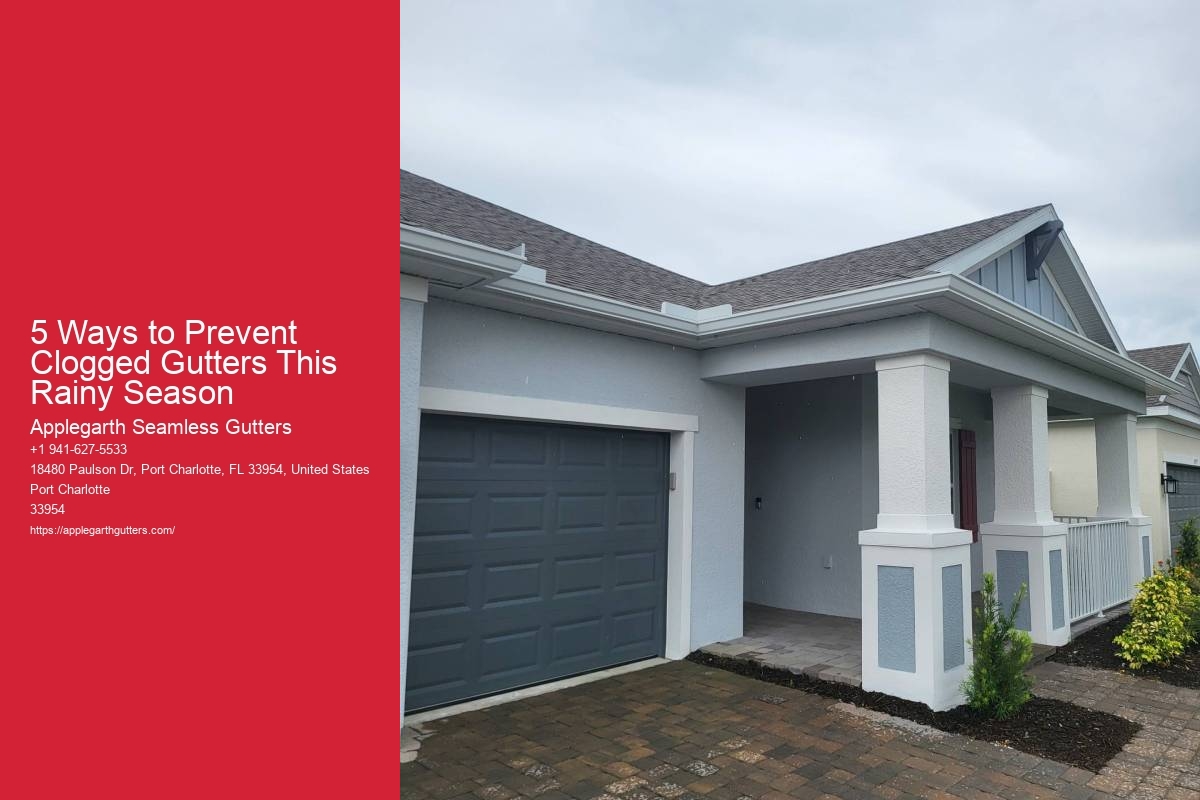
5 Ways to Prevent Clogged Gutters This Rainy Season
Oh, the rainy season rolls around and suddenly your roof looks like a waterfall waiting to happen.
Gutter Inspection
Seamless Gutter Installation
Vinyl Gutters
Gutter Replacement
Gutter Protection
Metal Gutters
Gutter Downspout Repair
Rainwater harvesting
Gutter Leak Repair
Rain Gutter Installation
Rain chain
Gutter Resurfacing
Stormwater Drainage
It's easy to ignore those narrow channels along the eaves, but they plays a big role in keeping water away from your foundation.
Residential Gutter Services
Water Damage Prevention
Rafter
Street gutter
Gutter Guard Installation
Fascia Gutter Installation
Copper Gutters
Weather vane
Roof
storm drain
Gutter Sealing
Storm drain
Gutter Cleaning
Roof Gutter Cleaning
Gutter Flushing
Tented roof
Here are five simple ways to keep them flowing (especially after a storm) - short, doable tips that won't take all weekend.
Schedule regular cleanings Get up there and remove leaves, twigs, and other debris before they build a dam. Learn more about Gutter Services in North Port here. Rain gutter The gutters needs attention at least twice a year, and more if you have lots of trees. If you dont like climbing ladders, hire someone - its not worth risking a fall.
Install gutter guards Mesh screens or foam inserts can cut down on clogs by stopping big stuff from getting in. Water Damage Prevention They ain't perfect, but they reduce how often you have to scoop nastiness out.
Box gutter
Gutter Maintenance
Gutter Repair
Leaf Guard
Seamless Gutter Installation
Vinyl Gutters
Gutter Replacement
Gutter Protection
Metal Gutters
Gutter Downspout Repair
Rainwater harvesting
Gutter Leak Repair
Rain Gutter Installation
Just check them once in a while so small bits dont still find a way to gather.
Check and fix pitch and seams Water should run toward the downspouts, not pool in the middle. Sometimes the channels sag or the seams leak, and that makes problems worse. Residential Gutter Services A quick tweak or sealant can save you from bigger repairs later - and prevents water from damaging fascia and siding.
Keep downspouts clear Leaves pile up at the base, and if the downspout gets blocked you'll be fighting backups even with clean gutters. Roof garden Run water through them (a hose works) to make sure it flows away from the house. If it doesnt, extend the outlet or add a splash block.
Trim overhanging branches Tree limbs that hang over the roof will drop constant debris; trim them back so fewer bits hit your channels. It also reduces moss and bird nests, which can be a real headache to remove.
Water Damage Prevention
Downspout Installation
Gutter Replacement Services
Roof garden
Gutter
Gutter Inspection
Residential Gutter Services
Gutter System Installation
Rain gutter
Box gutter
Raingutter regatta
Nobody wants to deal with water damage, and it usually is preventable with just a bit of care. Raingutter regattaGutter Inspection Do these things, and you wont be fixing rot or mold later. Rafter Dont wait - check them now!
Gutters, in bowling and table shuffleboard, the trough hazards on either side of the playing lane into which the bowling ball or shuffleboard puck may fall
This disambiguation page lists articles associated with the title Gutter.
If an internal link led you here, you may wish to change the link to point directly to the intended article.
Port Charlotte is a census-designated place and unincorporated community in Charlotte County, Florida, United States. The population was 60,625 at the 2020 census, up from 54,392 at the 2010 census. It is included in the Sarasota metropolitan area.
Port Charlotte was named to the "10 Best Places to Retire", in the United States for the year 2012 by U.S. News & World Report.[5]
The Calusa originally settled around the Port Charlotte area.[6] In 1819, Florida was ceded by the Spanish and became a U.S. territory, and in 1845 Florida became the 27th state. For the first 100 years of statehood, the area around Port Charlotte was mostly undeveloped. Maps of the area at the turn of the 20th century show that most of the roads and railroads leading into southwest Florida had bypassed the Port Charlotte area.[7][8] Aside from some cattle ranches and small farming, the area was mostly uninhabited. This would change when the post-World War II boom opened people's eyes to the possibility of developing land in Florida.
In the 1950s, the now defunct General Development Corporation led by the Mackle brothers decided to take advantage of the Florida land boom and developed land primarily on both of Florida's coastlines. Among the areas they planned and developed was the Port Charlotte area. Ultimately, Port Charlotte became the most populous community in Charlotte County, although like most GDC developments, Port Charlotte remained an unincorporated community.
Port Charlotte was severely impacted by Hurricane Charley on August 13, 2004. The hurricane, predicted to hit Tampa as a Category 2 hurricane, took a last-minute right hand turn and intensified into a Category 4 storm as it made landfall near Charlotte Harbor and caused severe damage in the city of Punta Gorda and in the Port Charlotte area.[9] The storm's 145 miles per hour (233 km/h) maximum sustained winds destroyed almost half of the homes in the county and caused heavy ecological damage to sensitive wetlands in the area.[9][10]
Just over 18 years later, Port Charlotte was once again severely impacted by a major hurricane, this time Hurricane Ian on September 28, 2022. Ian made landfall as a Category 4 storm in Cayo Costa State Park before moving north-east into Charlotte Harbor, with south-eastern Port Charlotte going through the eye of the storm.[11] Ian caused severe damage to Port Charlotte, mostly wind-related, and to the rest of the surrounding area.[12] Maximum sustained winds of 115 miles per hour (185 km/h) and a wind gust of 132 miles per hour (212 km/h) were reported by a private weather station in Port Charlotte.[13]
Port Charlotte is located at the north end of the Charlotte Harbor Estuary, northwest of the city of Punta Gorda. It is 100 miles (160 km) south of Tampa and 65 miles (105 km) north of Naples. According to the United States Census Bureau, the CDP has a total area of 32.3 square miles (83.7 km2), of which 28.4 square miles (73.6 km2) is land and 3.9 square miles (10.1 km2) (12.01%), is water.[14]
Since Port Charlotte is unincorporated, it is governed by the Charlotte County Board of County Commissioners. The county is governed by a 5-person county commission. They take turns rotating into the commission chair position every year. County commissioners frequently sit on other regional boards involving other municipalities and counties.
Port Charlotte CDP, Florida – Racial and ethnic composition Note: the US Census treats Hispanic/Latino as an ethnic category. This table excludes Latinos from the racial categories and assigns them to a separate category. Hispanics/Latinos may be of any race.
As of the 2020 United States census, there were 60,625 people, 25,925 households, and 16,077 families residing in the CDP.[22]
According to Sperling's Best Places, as of July 2015 the family median income in Port Charlotte was $48,911, and household income was $40,049. The per capita income was $22,681. Port Charlotte's unemployment rate was 5.50%, compared to 6.30% for the United States overall.
As of the 2010 United States census, there were 54,392 people, 24,501 households, and 15,658 families residing in the CDP.[23]
As of the census[2] of 2000, there were 46,451 people, 20,453 households, and 13,601 families residing in the CDP. The population density was 2,085.9/sq mi (805.3/km2). There were 23,315 housing units at an average density of 1,047.0 per square mile (404.2/km2). The racial makeup of the CDP was 89.23% White, 6.53% African American, 0.28% Native American, 1.14% Asian, 0.05% Pacific Islander, 1.18% from other races, and 1.59% from two or more races. Hispanic or Latino of any race were 5.16% of the population.
In 2000, there were 20,453 households, out of which 20.8% had children under the age of 18 living with them, 53.2% were married couples living together, 10.1% had a female householder with no husband present, and 33.5% were non-families. 28.2% of all households were made up of individuals, and 18.6% had someone living alone who was 65 years of age or older. The average household size was 2.25 and the average family size was 2.71.
In 2000, in the CDP, the age distribution of the population shows 18.7% under the age of 18, 5.4% from 18 to 24, 21.0% from 25 to 44, 24.2% from 45 to 64, and 30.7% who were 65 years of age or older. The median age was 49 years. For every 100 females, there were 87.7 males. For every 100 females age 18 and over, there were 84.2 males.
The gymnasium at Family Christian Academy, formerly known as Community Christian School
Public schools in Port Charlotte are operated by Charlotte County Public Schools.[26] For the 2007-08 school year, all schools in Port Charlotte received A's from the Florida Department of Education.[27]Port Charlotte High School is the only traditional public high school located in Port Charlotte, although some parts of Port Charlotte are considered part of Charlotte High School's area, and students have the option to attend Charlotte Virtual School, a charter school, a special needs school, or a different traditional public high school through school choice.[28] There are numerous private schools in Port Charlotte,[29] including Family Christian Academy (formerly known as Community Christian School),[30] Charlotte Preparatory School (formerly known as Charlotte Academy),[31] Genesis Christian School,[32] Joyful Noise Learning Center, Port Charlotte Adventist School,[33] Port Charlotte Christian School, and St. Charles Borromeo Catholic School.[34] Port Charlotte is home to three small higher education facilities, including Charlotte Technical College,[35]Southern Technical College's Port Charlotte campus,[36] and Southwest Florida Bible Institute.[37]
The Mid-County Regional Library and the Port Charlotte Library are located in Port Charlotte. They are included in the Charlotte County Library System.
1963 – The Port Charlotte, Punta Gorda, and Englewood Public Libraries joined and formed the Charlotte County System.
1968 – The Port Charlotte Library moved to the Cultural Center of Charlotte County, the present location.
1985 – The Murdock Library was established as the library system administrative facility.
1996 – The Charlotte County Library System updated circulation with an automated catalog system.
2005 – Murdock Public Library moved to the new Mid-County Regional Library facility.
2022 – The Mid-County Regional Library and Port Charlotte Public Library were both damaged and temporarily closed as a result of Hurricane Ian. However, the latter reopened in November of the same year while Mid-County Regional Library remains under repair. Each location had hours extended on certain days to accommodate the continued closure of Mid-County Regional Library. Customers were able to pick-up holds from Centennial Park Recreation Center north of Port Charlotte.[39]
^Houck, Douglas; et al. (Charlotte County Historical Center Society) (2011). Historic Charlotte County: An Illustrated History. San Antonio, Texas: Historical Publishing Network. ISBN9781935377337. OCLC711782527.
^"Walter Minx". Roberson Funeral Home & Crematory. Retrieved February 4, 2025.
^Martin, Douglas. "Dr. Thomas C. Peebles, Who Identified Measles Virus, Dies at 89", The New York Times, August 4, 2010. Accessed July 18, 2024. "Dr. Thomas C. Peebles, whose D in college biology belied a keen aptitude for medical research that led him to make landmark scientific advances including identifying the virus that causes measles, died on July 8 at his home in Port Charlotte, Fla."